Beyond Seniors
Caring for a spouse with dementia Why the isolation is steeper, and what to do about it
Updated September 2026
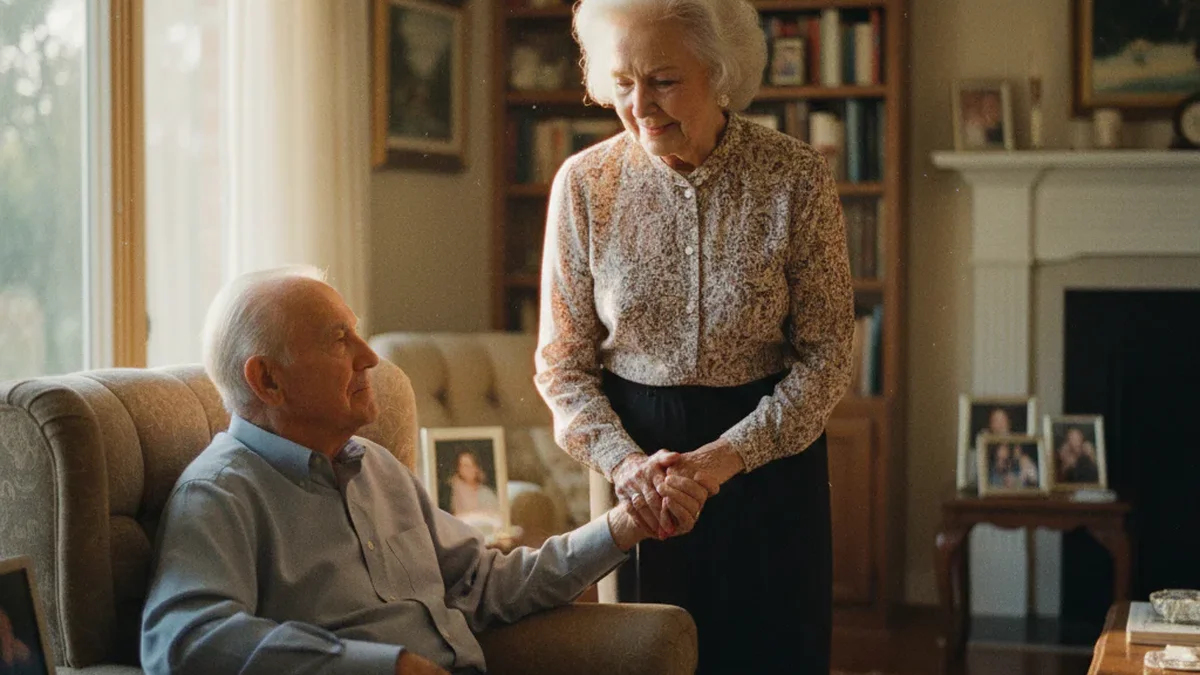
Article images are AI-generated illustrations. Some may include AI-generated people; they are illustrative and do not depict real caregivers, patients, experts, or FamilyCareWise contributors.
TL;DR: Isolation is the measured difference. In a Canadian study following 5,226 family caregivers, spouses became more socially isolated over time, and more steeply than adult children did. The Alzheimer's Association's advice for a caregiver who suspects depression is to see a doctor as soon as possible.
When a spouse has dementia, one person ends up holding the marriage, the money, the driving and the paperwork. The National Institute on Aging notes that a primary caregiver, especially a spouse, may be hesitant to ask for a break.
The tasks are the visible half, and the Alzheimer's Association's page on changes to your relationship describes the other half. A new role arrives as the other person's memory declines, and decisions that used to be shared stop being shared. Financial and legal tasks such as balancing the checkbook and doing taxes may pass to the spouse who never handled them. That page says a caregiver in this position may be feeling enormous grief over the changes, and it tells that reader plainly: you are not selfish for experiencing these feelings.
Both halves arrive on the same day, and neither waits for the other to finish. What follows is the evidence on how spousal caregiving differs from a son's or a daughter's job, and then the paperwork whose deadline is set by law, and where the two national organizations most families reach for first tell a spouse to go for relief.
Isolation rises faster for spouses than for adult children
Lun Li, Andrew Wister and Barbara Mitchell analyzed two waves of the Canadian Longitudinal Study on Aging. Their result ran in The Journals of Gerontology Series B in 2020. The sample was 5,226 family caregivers. Of those, 1,293 were caring for a spouse or partner and 3,933 for a parent or parent-in-law. Both groups reported greater social isolation over time. Spousal caregivers showed a steeper increase from baseline to the follow-up wave than adult-child caregivers did.
Two features of the spousal role explain part of that gap, in the authors' own account. Spouses tend to be older, and so have lower functional ability. Spouses are also far more likely to be the primary caregiver, and to live with the person they care for. That means more hours and a wider range of tasks. The paper adds a third point: spousal caregivers are less likely to use community services than other family caregivers do, and they receive less support from other family members or friends.
The same paper then complicates its own finding, and the complication is worth following. Li and colleagues call the comparative literature equivocal on which group is more challenged overall. They describe it as paradoxical that several studies show less caregiver burden, better psychological well-being and higher quality of life among spouses than among adult children. Their explanation is that adult children juggle employment and parenting alongside the caregiving, and tend to be less prepared for the role. A spouse more often reads caregiving as part of the marriage. The narrow claim is the one their own data supports, which is that the isolation trajectory is steeper for spouses, while the wider comparison of burden and well-being stays contested.
One scope note matters for a reader in the United States: that study covered Canadian family caregivers of every kind, not dementia caregivers alone. The Alzheimer's Association's Alzheimer's Disease Facts and Figures summary carries the dementia-specific picture. Most caregivers, 66%, live with the person with dementia in the community, and 59% of dementia caregivers report feeling high to very high emotional stress.
The grief starts years before the death
Kesstan Blandin and Renee Pepin published a model of dementia grief in the journal Dementia in 2016. They build it on ambiguous loss, a concept they credit to the family researcher Pauline Boss. Their definition is a lack of clarity due to losses that are unstable and fluctuating, evading finality and resolution, and in dementia, they write, the person may not appear to be the same person, or may be psychologically inaccessible. A family member may be mourning a hoped-for future instead of a completed event.
Two of their observations land hardest on a spouse, and the first is that ambiguous loss is rarely recognized by family members themselves or others. The grief runs without the acknowledgment that follows a death. The second is that a final resolution of grief cannot typically occur until physical death. The authors note this state can be prolonged for years. Ambiguous loss is not unique to spouses; our guide to caring for a sibling after a traumatic brain injury names the same term for grief over someone who survived changed.
The Alzheimer's Association reaches the same place in plainer language, and its page on grief and loss as Alzheimer's progresses says one thing first: it is normal to feel loss when you care about someone who has Alzheimer's disease. That page adds that the stages of grief do not happen neatly in order, and that a caregiver should prepare to experience feelings of loss more than once. It also names the reaction most spouses recognize from outside the house. Some people may not understand your grief, because most people think grief happens when someone dies.
That page carries one instruction, and it is this: if your grief is so intense that your well-being is at risk, the Alzheimer's Association says to ask for help from your doctor or a professional counselor. Knowing which changes are coming can take some of the ambiguity out of the year ahead. Our stage-by-stage guide to Alzheimer's caregiving covers what to expect at each stage and how the caregiving role changes with it.
Intimacy changes, and the guilt about it is common
Spousal caregivers rarely raise this with anyone. The Alzheimer's Association's willingness to write it down is the useful part, and its relationship-changes page states that it is typical for people with Alzheimer's disease to experience changes in their sexual drive. The change runs in both directions. Depression, physical illness and some medications can reduce interest in sex. Dementia can also cause an increase in sexual interest and desire.
The same page then turns to the caregiver's side. It says it is common for caregivers to lose sexual desire. The reasons it gives are the demands of caregiving, the transition from intimate partner to caregiver, and changes in a partner's personality as dementia progresses. Its instruction to that reader is one sentence long: do not feel guilty if your attraction to your partner has changed.
Emotional intimacy goes the same way and is harder to name, because there is no diagnosis for the end of the daily exchange of thoughts, memories and shared history that holds a long marriage together. The Alzheimer's Association's practical answer is other people who are living it. It runs a free 24/7 Helpline at 800.272.3900, staffed for care planning, stress and communication questions. It also runs an online community called ALZConnected and support groups across the country, and its caregiver stress page points caregivers to all three.
Legal capacity sets the deadline on the paperwork
This section reports what two national organizations publish about legal documents. It is not legal advice. Laws vary by state, and an attorney licensed where you live is the person who can apply any of this to your marriage.
The National Institute on Aging's page on legal and financial planning for people with Alzheimer's states the constraint directly. Advance directives for financial planning must be created while the person still has the legal capacity to make decisions. That is the deadline, and the disease sets it. NIA lists five documents to consider, and they are a living will, a durable power of attorney for health care, a will, a durable power of attorney for finances, and a living trust.
The Alzheimer's Association's page on legal documents adds two points a spouse is likely to get wrong. Signing a power of attorney does not hand the agent authority to override the person's own decisions, and that page states the person living with dementia keeps the right to make their own decisions as long as they have legal capacity. The agent's authority begins where capacity ends. The second point concerns couples who are not in legally recognized relationships. That page says they are especially vulnerable to limits on deciding for each other, and may be unable to obtain information about a partner's health status if the documents are not completed.
Cost is the usual reason this gets postponed. NIA states that families who cannot afford a lawyer can still prepare documents and express their wishes in advance. It names state legal aid offices, state bar associations, Area Agency on Aging officials, local nonprofit agencies and social service agencies as sources of legal assistance and referrals. For a paid attorney, NIA points to the National Academy of Elder Law Attorneys, a local bar association or a local library.
Driving decisions carry a state-law layer
The National Institute on Aging's page on driving safety and Alzheimer's disease starts from one fact. People with dementia often do not realize they are having driving problems, which is why NIA asks family members and friends to observe the person's driving for signs that it is no longer safe, and it states that in the early stages some people are able to keep driving. At some point it will no longer be safe to be behind the wheel.
State law sits underneath the conversation at home. NIA writes that state laws vary regarding when a person with Alzheimer's should stop driving. Some states will automatically revoke a license when a person is diagnosed with Alzheimer's or another form of dementia. Others may offer the chance to take and pass a driving test. A few states require physicians to report any diagnosis of dementia to the state's department of motor vehicles. Checking your own state's DMV is the first move, because the answer changes what the conversation is even about.
NIA lists these steps for a family that has decided the driving has to stop:
- Talk about your concerns with the person
- Have driving skills assessed by a professional; the American Occupational Therapy Association maintains a national database of driving specialists, and there may be fees
- Take the person for a driving test or risk screening at the state DMV
- Ask the person's doctor to tell them to stop driving; NIA notes the doctor can write "Do not drive" on a prescription pad that you can show to the person
- If necessary, hide the car keys, disable the car, move it out of sight, or consider selling it
NIA is blunt about the stakes. If the person keeps driving when it is no longer safe, someone could get hurt or be killed. It pairs that with the transport replacement. Losing the ability to drive is losing one form of transportation, and NIA lists the others. Free or low-cost buses, taxi and similar private transportation services, and carpools for older people are on that list. So are volunteer drivers from churches and community groups. The Eldercare Locator at 800-677-1116 connects a family to what exists locally.
Older spouses are caregiving while aging themselves
The Alzheimer's Association's Facts and Figures summary answers who the caregivers are. About 30% of caregivers are age 65 or older, in that section's own words. The same section counts nearly 13 million Americans providing unpaid care for a family member or friend with dementia. A spouse in their seventies doing daily transfers, medication management and overnight supervision sits inside both numbers.
NIA's page on taking care of yourself as a caregiver puts the risk in one passage. Caregivers are less likely than others to get preventive health services such as annual checkups, and to practice regular self-care, and as a result they tend to have a higher risk of physical and mental health issues, sleep problems, and chronic conditions such as high blood pressure. NIA adds, in its own words, that caregivers "are even at an increased risk of premature death."
The Alzheimer's Association is specific about frequency. Its healthy caregiver page says to visit your physician regularly, at least annually, and adds that any exhaustion, stress, sleeplessness, or changes in appetite or behavior should be taken seriously, because ignoring these symptoms can cause your physical and mental health to decline. Its caregiver stress page adds a threshold. If you experience its listed signs of stress on a regular basis, make time to talk to your doctor.
Depression is a separate condition from stress, and the Alzheimer's Association treats it separately. Its caregiver depression page lists the signs. They include feelings of hopelessness, feelings of worthlessness or guilt, disturbed sleep and fatigue, and the list continues with loss of interest or pleasure in usual activities, changes in appetite and weight, and thoughts of death, dying or suicide. That page says that if you are concerned you might be depressed, see your doctor as soon as possible. The 988 Suicide and Crisis Lifeline is available 24/7/365, and states that conversations there are free and confidential. Our guide to caregiver burnout signs, stages and recovery covers the warning signs and the recovery steps in more detail.
Where does a spouse actually get a break?
NIA defines respite care as short-term relief for primary caregivers. It gives them time to rest, travel, or spend time with other family and friends. The care may last anywhere from a few hours to several weeks at a time. It can take place at home, in a health care facility, or at an adult day care center. To find programs, NIA points families to the ARCH National Respite Locator Service, which searches state-sponsored programs, adult day care centers and services for veterans.
Money is the next question, and NIA answers it in parts. NIA states that respite provided by a friend, relative or volunteer may have no associated cost, while professional services charge by the hour, or by the number of days or weeks provided. Most private health insurance plans do not cover respite care, and some long-term care insurance plans may have coverage for it. For a person receiving hospice care, NIA states that Medicare will cover most of the cost for up to five consecutive days of respite care in a hospital or skilled nursing facility. Medicaid also may provide payment assistance. Coverage rules vary by plan and by state, so confirm your own situation with the plan or program before counting on it.
For a spouse, the harder part is asking. NIA writes that a primary caregiver, and especially a spouse, may be hesitant to ask for a break, and it adds that many caregivers later say they did too much on their own, and wished they had asked for more support from family and friends. Its suggestions for making the ask easier are small and concrete. Ask for small things first. Send a text or an email if asking face to face is hard. Match the ask to what the other person is good at or interested in, and keep a list of caregiving tasks that could be divided up. NIA even supplies the sentence to say when someone offers.
If your partner's dementia began before 65, the systems built for elder care fit badly. The money questions also arrive earlier. Our guide to young-onset dementia caregiving covers the Medicare gap, job loss, the SSDI application and the legal documents on that timeline.
Memory care starts where 24-hour supervision does
The Alzheimer's Association's page on residential care names the threshold. During the middle stages of Alzheimer's, it becomes necessary to provide 24-hour supervision to keep the person with dementia safe. As the disease progresses into the late stages, the around-the-clock requirements become more intensive, and that page says there may come a time when the person needs more care than can be provided at home. NIA names the same threshold from the other direction. A person with dementia may require around-the-clock care, or exhibit behaviors such as aggression and wandering, that make it no longer safe to stay at home.
Both organizations treat the guilt as expected. The Alzheimer's Association writes that even a planned move into residential care can be a stressful experience. A caregiver may feel guilty and wonder whether they are doing the right thing, and that page says these feelings are common. Its summary of what families report back is short. It is best to gather information and move forward, and wherever the care happens, the decision is about making sure the person receives the care they need.
The label on the building repays a close look, because the Alzheimer's Association states that assisted living is not regulated by the federal government, and that its definitions vary from state to state. Not all assisted living providers offer services designed for people with dementia, so that page says it is important to ask. Dementia special care units exist inside several kinds of community, and they may or may not be locked. Some states require nursing homes and assisted living residences to disclose fees and list the specialized services a special care unit provides.
When you go to look, the Alzheimer's Association gives a short list. Plan to visit several care communities. Make an appointment for the first visit, and also make one or two unannounced visits. Look around, and talk with the staff as well as with residents and their families.
Frequently Asked Questions
How is caring for a spouse with dementia different from caring for a parent?
The clearest measured difference is social isolation. Li, Wister and Mitchell analyzed 5,226 family caregivers in the Canadian Longitudinal Study on Aging, and published the result in the Journals of Gerontology Series B in 2020. Both spousal and adult-child caregivers grew more socially isolated over time. Spouses showed a steeper increase than adult children did. The same paper reports that the wider comparison is unsettled, with some studies finding less burden and better well-being among spouses. That study covered Canadian family caregivers generally, not dementia caregivers only. The Alzheimer's Association names a second difference for spouses: the loss of shared decision making, changes to intimacy, and grief over the relationship itself.
What is ambiguous loss in dementia caregiving?
Ambiguous loss is a term from the family researcher Pauline Boss. Blandin and Pepin, writing in the journal Dementia in 2016, describe it as a lack of clarity from losses that are unstable and fluctuating, evading finality and resolution. They note that ambiguous loss is rarely recognized by family members themselves or others. In their account, a final resolution of grief cannot typically occur until physical death. The Alzheimer's Association makes the same point in plainer words on its grief and loss page. It is normal to feel loss when you care about someone who has Alzheimer's, and that page tells caregivers to prepare to experience feelings of loss more than once. If grief is intense enough that your own well-being is at risk, that page says to ask for help from your doctor or a professional counselor.
When should a spouse consider memory care instead of caring at home?
This is a medical and safety judgment to make with the person's own clinicians. A website cannot set the threshold for one household. The Alzheimer's Association writes that during the middle stages of Alzheimer's it becomes necessary to provide 24-hour supervision to keep the person with dementia safe. That page adds that there may come a time when the person needs more care than can be provided at home. The National Institute on Aging names around-the-clock care needs, and behaviors such as aggression and wandering, as the point where staying at home is no longer safe. Both organizations treat guilt about the move as common.
Is it normal to feel lonely while still married to a spouse with dementia?
Loneliness inside the marriage is a documented part of this role. The Alzheimer's Association tells caregivers directly that they are not selfish for grieving the changes in the relationship. That page also says not to feel guilty if attraction to a partner has changed. Its grief and loss page lists withdrawing from social activities among the reactions caregivers have. Loneliness and depression are different, and they need different responses. The Alzheimer's Association lists hopelessness, disturbed sleep, loss of interest in usual activities, and thoughts of death, dying or suicide among the signs of depression. That page says to see your doctor as soon as possible if you think you may be depressed. The 988 Suicide and Crisis Lifeline is free, confidential and available 24/7/365.
The information on this page is for educational purposes only and does not constitute medical, legal, or financial advice. Every family's situation is different. Please consult a qualified healthcare provider, licensed attorney, or certified financial planner for guidance specific to your circumstances.